





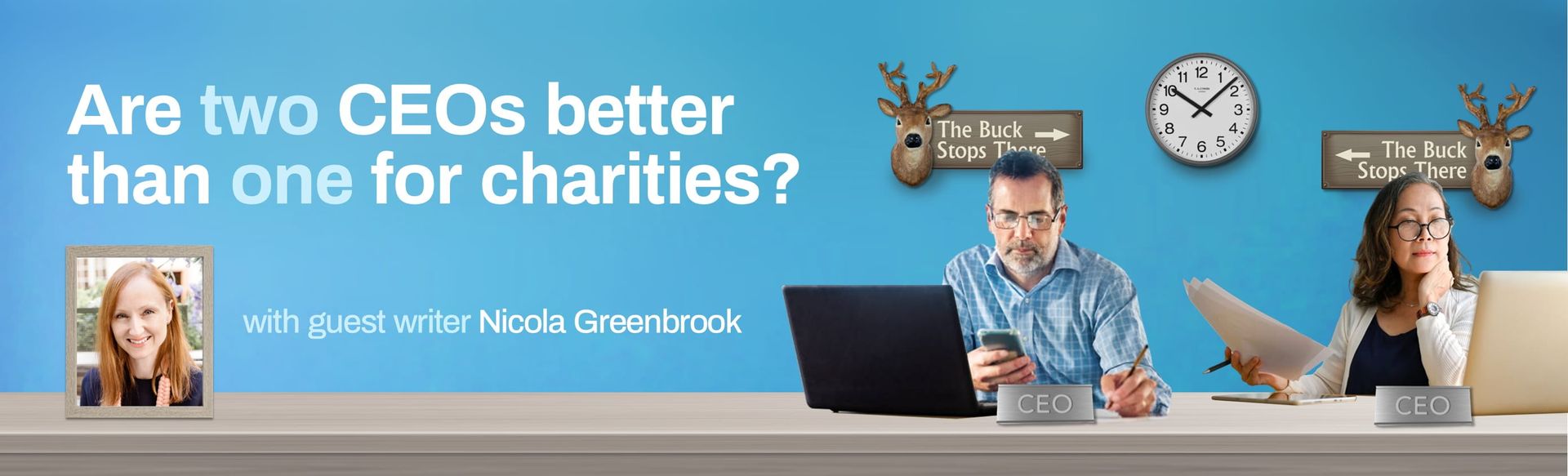
Are two CEOs better than one for charities?
Nicola Greenbrook • March 19, 2026
It's not the typical job-share nor exempt from the challenges they can pose, yet a growing number of charities are choosing to appoint not one, but two CEOs.
Whether it's driven by concern for wellbeing, the scope of the role, or simply the absence of anyone willing to shoulder the responsibility alone, sharing the leadership can have a number of benefits, but is it the right move for you or your organisation?
Guest writer Nicola Greenbrook explores not-for-profit co-leadership and the pressures facing charity leaders today.
Back in 2022, Greenpeace UK appointed Areeba Hamid and Will McCallum as its new joint Executive Directors. It was the first time in the environmental group’s UK office history that responsibility for the role was held by two people, a move that underlined the strategic value of a shared structure.
Since then, the co-CEO model appears to be having a moment, and perhaps for good reason. For one thing, it’s lonely at the top, and in a world of complexity and relentless uncertainty, the role of a CEO can be a heavy burden to carry alone.
With CEOs reporting burnout, strategic overload and under-supported leadership environments, the question may no longer be why share the role, but why not?
What is the co-CEO model?
In a co-CEO structure, the chief executive title, leadership responsibilities and decision-making power are intentionally shared among more than one CEO.
Rather than one individual holding singular authority, two leaders jointly oversee the organisation. There can be different configurations, depending on an organisation’s specific needs. For example, one CEO may be more internally facing with a focus on operations, people and service delivery. The second co-CEO could then become the external face of the organisation, with responsibility for fundraising, advocacy and donor relationships.
While this approach is just beginning to gain traction in the charity sector, it's more established in areas like the arts, where the case for putting creative endeavours and business matters in different hands is well understood.

Co-leadership in the charity sector
Rarely seen until recently, in the last year alone some of the UK’s most prominent charities have chosen to adopt a shared leadership structure.
In July 2025, anti-poverty and food bank charity Trussell announced the appointment of co-CEO Matthew van Duyvenbode alongside the charity’s existing leader, Emma Revie. The charity viewed this strategic decision as an opportunity to “gain the benefits of shared leadership at minimal additional cost – strengthening our ability to respond with agility, ensure continuity and support our community of food banks.”
LGBT+ anti-abuse charity Galop appointed Ben Kernighan and Jasmine O’Connor as co-Chief Executives in August 2025 to champion Galop’s life-saving work. A month later, when family support charity Home-Start UK appointed its first co-CEOs, Natalie Acton and Jodie Reed, it was the first time in the organisation’s 50-year history that a joint leadership structure had been embraced.
In January 2026, ActionAid UK announced the appointment of Hannah Bond and Taahra Ghazi as its permanent co-Chief Executive Officers, as the organisation began a new phase of feminist leadership and strategic transformation.
At the time of writing, Annabel Cook and Louise Govier are set to lead youth charity Artswork Limited from April 2026, working together as co-CEOs, pooling their strengths and talents to provide the charity with “increased leadership capacity and resilience at a time of significant change across the cultural sector.”

We should note that developments like these are almost always presented as a planned, strategic decision and the logical next step, making it difficult to tell a charity's first choice of action from something closer to a last resort.
However, in only one of the cases mentioned so far were two individuals actively hired as co-CEOs (Home-Start UK), which suggests it may not always be the original intention. Elsewhere and more often, the arrangement has evolved around someone who is already leading the organisation, often in an interim capacity, casting co-leadership as more of a practical, one-off solution to keep them on board than any broader strategic choice.
Nonetheless, whatever the reason behind it, having the support of someone else at their own level can certainly help CEOs to handle the challenges that inevitably come with the role.

The weight of the modern charity CEO role
Despite job satisfaction and commitment amongst charity sector leaders, findings from the ACEVO Pay & Equalities Survey 2025 make for difficult reading, with pay inequality, limited career progression and challenges in wellbeing and diversity.
Key data included:
- Wellbeing and balance: Less than half (49%) of CEOs surveyed were satisfied with board support for their wellbeing and only 53% felt satisfied with work-life balance
- Career progression: Fewer CEO’s are satisfied with the time dedicated to personal learning and development (down to 38%). While 75% of CEOs’ time is spent on solving day-to-day, immediate issues, around 25% is spent on strategic thinking and planning.
- Leadership inequalities: The survey found that only 6% of CEOs identify as Asian or Minoritised Ethnic, and no Black CEOs responded to the survey. Whilst 76% of CEOs received a pay lift in their current role (up from 68% in 2024) the gender pay gap remains in double figures at 10.6%. Male CEOs were reported as earning a median of £64,067 and female CEOs £57,250.
It doesn’t stop there. Burnout is insidious in the charity sector, and the Directory of Social Change acknowledges that the commitment and drive to making a positive impact can fuel relentless work and dedication. This can lead to stress, exhaustion and overwork if not appropriately managed.
Sharing the CEO role could be one way of reducing the pressure on any one individual, providing them with greater support, while it can also give a broader range of people a more accessible pathway into charity leadership.

Shared leadership: the opportunities...
Far from diluting leadership, the co-CEO model could actually strengthen it, bringing together complementary skill sets, reinforcing decision-making and developing the leadership pipeline.
Modern leadership is challenging in any sector. With AI and other emerging technologies, funding instability and continuous public scrutiny, co-leadership could also be a strategic way to adapt to this organisational complexity.
Writing for the Directory of Social Change, Ruth Davison considers if job sharing at senior level could be a way to push wider systemic change. She references the charity Womankind Worldwide, who appointed Disha Sughand and Diana Njuguna as its first co-CEOs. The organisation described it as representing “a paradigm shift in leadership and decision-making” and about “modelling feminist collaboration based on mutual respect, equity, trust, intersectionality, and a shared feminist vision” as well as sharing responsibilities.
Embracing a shared leadership model is also an example of dynamic, inclusive leadership. When Home-Start UK appointed their joint CEO’s, Chair of Trustees Lin Hinnigan said the decision demonstrated their “commitment to being an inclusive employer”, adding that exploring new leadership models, including co-leadership, was central to increasing diversity at the top.
Rather more prosaically, a second CEO can also provide cover for holidays, illness and emergencies, cutting down the 30 or so days or so that other workplaces battle through sans-CEO to somewhere close to zero, making the organisation more resilient and better able to respond to developments at speed.
…and challenges
Of course, a shared leadership model comes with its own pitfalls.
- A successful co-CEO structure requires an excellent working relationship between the leaders that can withstand high-pressure situations, based on mutual respect, in which each has absolute confidence in the other's decisions. Any clashes or disagreements may have a damaging impact throughout the organisation.
- Finding CEOs with that kind of chemistry who are equally happy to share the credit is a tall order once. Doing it again if one leaves is like winning the lottery twice: not technically impossible, but you're definitely going to want a strong plan B.
- Different leadership and communication styles risk sending mixed messages to employees, stakeholders and beneficiaries. Whose opinion prevails if they don't align?
- Delayed decision-making can be a major issue, especially if areas of responsibility are not clearly defined.
- Even if they are, dilemmas can still arise: something happens and an urgent comms decision needs making on a Tuesday morning, just when your comms-leading CEO isn't there. Stepping in risks stepping on their toes and a potential blunder, yet the consequences of not doing so may be worse.
- An extra head at this level represents a considerable cost, meaning it may only be viable at the expense of another senior post.
Shared leadership needs trust and board support, clear lanes of responsibility and strong communication to reach its full potential. The NCVO suggests that successful collaboration involves proactive planning, honesty and bravery from all sides.

Final thoughts
While having a shared leadership structure might not be right for every charity, the factors that appear to be driving its popularity make for a compelling case.
Having two leaders at the helm could mean a charity is resilient, leads with care and is equipped to handle whatever comes next in an often unpredictable world.
Maybe two heads really are better than one...
Nicola Greenbrook
London-based writer and podcaster
Contact Nicola: nicolagreenbrook@gmail.com

Our thanks to Nicola, and if you'd like to discuss any potential CEO opportunities or requirements (shared or otherwise), don't hesitate to contact our Executive Search team who will be happy to oblige.
You'll find their details on our
Executive homepage,
or email
executive@harrishill.co.uk

By David Young
•
September 2, 2026
What's happening in the charity recruitment market, and what are the challenges for those seeking new roles or new talent in the sector? Here's our report from the brand new 2026 Harris Hill Salary Survey.
By David Young
•
July 8, 2026
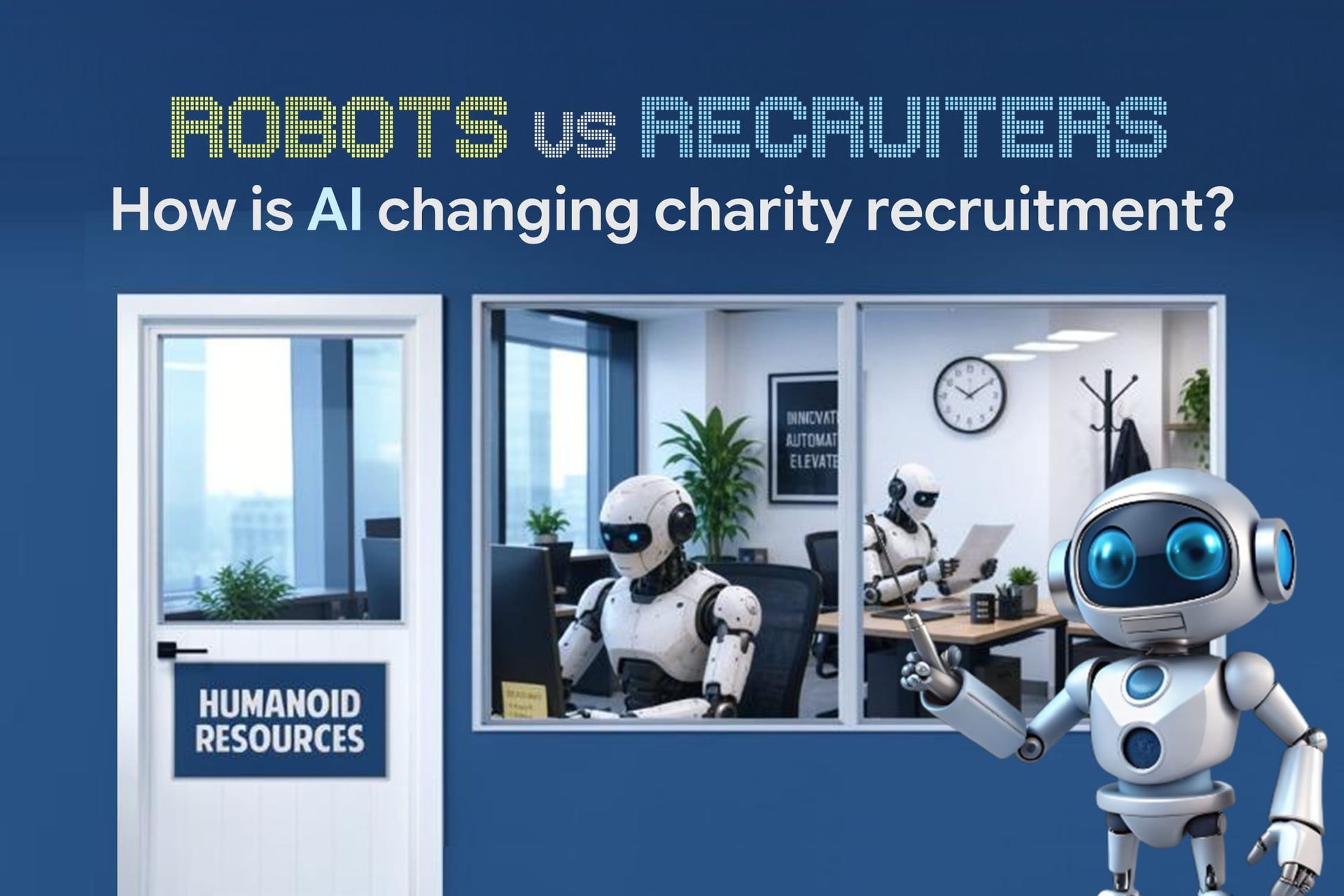
With AI tools already changing the charity recruitment process, we examine the current state of play, discover the pros and cons of letting robots do your recruitment, and ask if there's any real substitute for human expertise.