





Charity salaries: the ten-year trends
David Young • August 11, 2025
How have charity salaries progressed in the last 10 years? Who's seen the highest and lowest increases? And how has the sector fared against others and the cost of living?
Our 2025 Salary Survey gives us a tenth year of directly comparable data, so this time, along with the latest rates for third sector jobs, we look at the longer-term changes too, travelling back to 2015 to compare rates of pay then and now.
How well has your salary kept up with the times?

How we’ve made these comparisons
Salaries for any given role fall within a certain range (e.g. £42,000 - £48,000) which is what appears in our survey. However, comparing ranges can be misleading if they vary in width from year to year, as indeed they do.
For a clearer picture, we’re using a single value – the exact midpoint of each range (e.g. £45,000 in the above case) as an approximation of the average. We're then calculating the change in that figure between our 2015 and 2025 surveys, to compare 2015 salaries in six key charity departments with those of the same roles today.
It’s not perfectly scientific: for one thing, the figures aren’t weighted for the relative number of people in each role (managers outnumbering heads of department, for example), but it gives us a reasonable approximation of the relative increases in each area and across the sector as a whole.

2015: Setting the scene
Cast your mind back if you can, to what might now seem like the halcyon days of 2015.
Set to be described by future historians as ‘the year before it all went horribly wrong’, it was a time of (relative) peace, when the world was yet to be (quite so often) on fire, when a certain president was merely the host of a reality TV show, and when the Grim Reaper’s hectic year of bumping off beloved entertainers on a weekly basis was yet to get underway.
A pint of milk cost 44p, a pint of beer just £3.45 and hot topics in the charity sector included the recently-introduced Lobbying Act, described as a ‘gagging law’ by charities like Shelter and Friends of the Earth, while debate raged over the ethics of fundraising, after 92-year-old poppy seller Olive Cooke sadly took her own life, many holding the flood of donation requests she'd been receiving at least partly responsible.
Elsewhere, Queen Elizabeth II became the UK’s longest-reigning monarch, 195 countries signed the Paris climate agreement, while the internet tackled an even more pressing concern: what colour was that black and blue dress?
Since then of course, it’s been a bumpy ride in this handbasket, while for reasons that don't need reiterating here, the cost of simply existing has risen substantially. The question is: have salaries in the charity sector done the same? [Spoiler alert: let’s just say it’s unlikely].
Break out the bar charts! We’re going in.
(Contains scenes of mild peril).

How much does this matter?
It’s not great news, clearly, and certainly explains why your budget never seems to stretch as far as it did, but it’s hardly shocking news that however competitive they claim to be, salaries in the charity sector aren’t about to win any prizes.
That’s widely expected, and while inflation-busting increases all round would clearly be desirable, most in the sector are well aware of the trade-offs that would be required, and that they would very likely oppose.
Right now, back in a world where candidates compete for jobs rather than the other way around, the impact on recruitment is limited, but what these figures show is charity salaries falling further behind those in other sectors all the time, with concerning implications for the future.
In a less employer-friendly market, letting that gap grow any larger could significantly damage organisations’ ability to retain and hire new talent, and therefore to achieve their goals.
Thankfully, there’s a saving grace to help us finish on a brighter note. Much as we’ve focused on pay (as salary surveys tend to do), it’s worth remembering that in practice, and for charity professionals in particular, it’s not all about the money. Let’s be honest: if it were, we’d all be working somewhere else.
Staff in the sector may not make huge sums, but surveys consistently find them with higher levels of job satisfaction, a better work/life balance, and more passion for what they do than those in almost any other line of work, which is why they’re regularly ranked among the happiest workers in the UK.
Salaries aside, that’s surely something to go out and celebrate. Just make sure it’s somewhere with a deal on.
For more on charity sector salaries and the latest figures, you can find the full 2025 Harris Hill Salary Survey here, or for any other queries or assistance with recruiting or your next move, please contact our specialists, call us on 020 7820 7300, or send us an email.

Fundraising
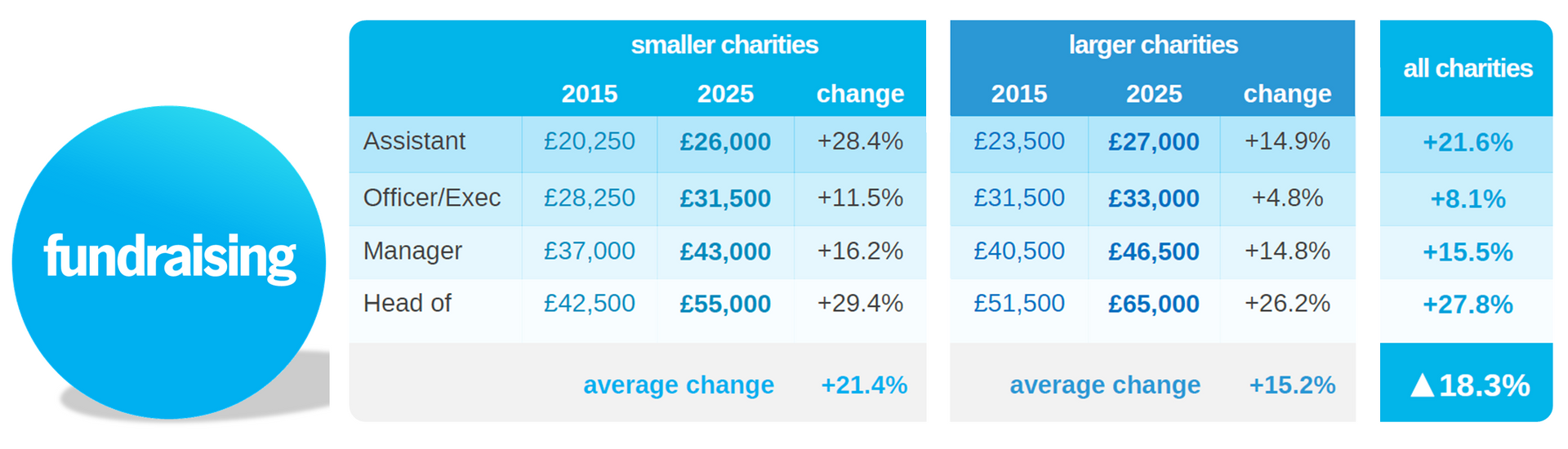
With an average rise of 18.3% in total, fundraisers have seen the greatest improvements in pay over the last ten years, largely thanks to their scarcity. Those at each end of the scale have seen the highest percentage increases, although as those at the bottom might reasonably point out, even 28% of not very much is still…not very much.
Drilling further into that overall average, there are some significant variations between revenue streams, with salaries for Trust & Statutory roles rising an average of 19.6% and topping the table, while those in Direct Marketing have had to make do with a mere 3.7%. In a decade. Tough gig.
Operations
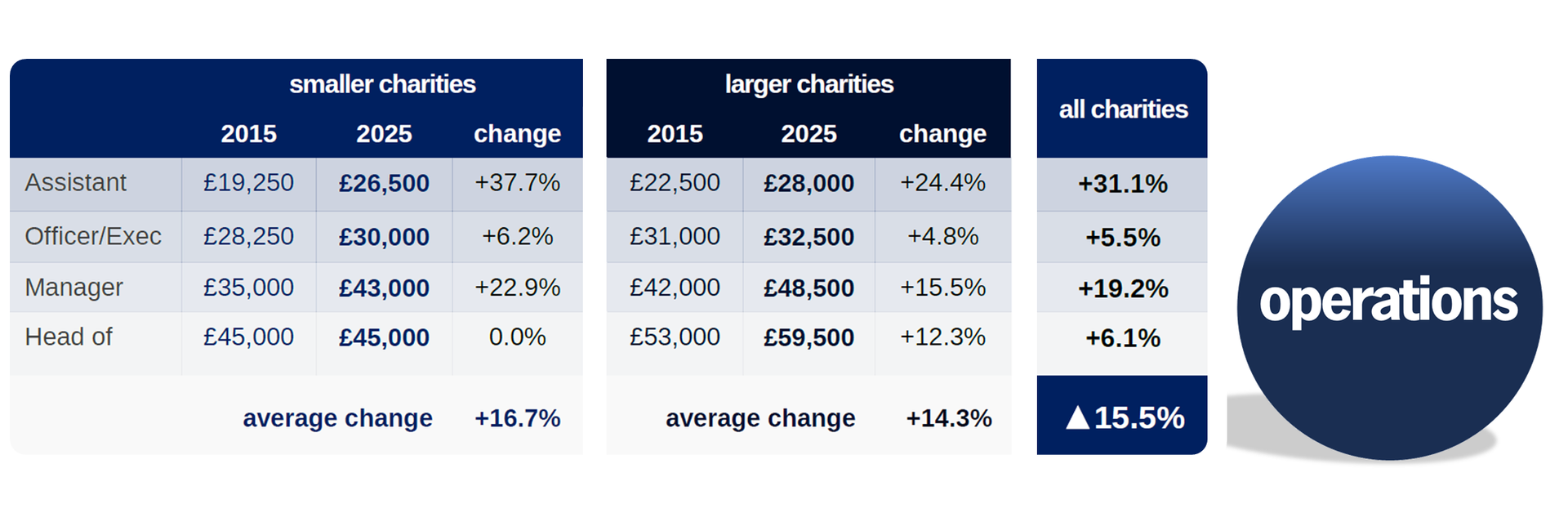
After fundraisers, it's those working in operational and service delivery roles who've seen the greatest improvements, with average increases of 15.5%. As in fundraising, some of the highest percentage increases have been at the most junior level, albeit in large part due to starting from a very low base.
Further up, increases have followed a similar pattern across the board apart from the heads of department, where those in large organisations have been rewarded, if not lavishly, at least more respectably (+12.3%) than their counterparts in small charities (a big fat zero).
Data Management
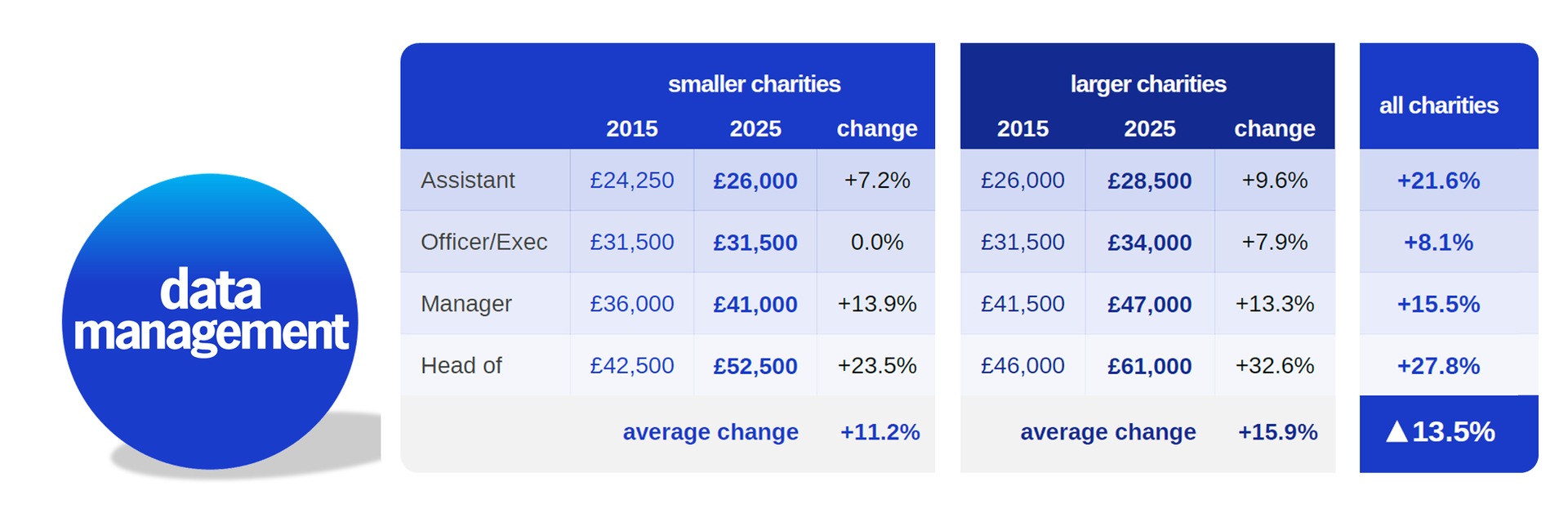
More than in any other area, salary increases for data management roles have primarily gravitated to those at the upper levels, which might explain why this is also where the gap between rates of the highest and lowest earners has widened the most, by approximately 54%.
That’s followed by Fundraising (+33%) and Marketing (+10%), but in Finance, Operations and HR, the gap between the highest and lowest-paid staff has actually narrowed, by 6%, 12% and 13% respectively.
Finance
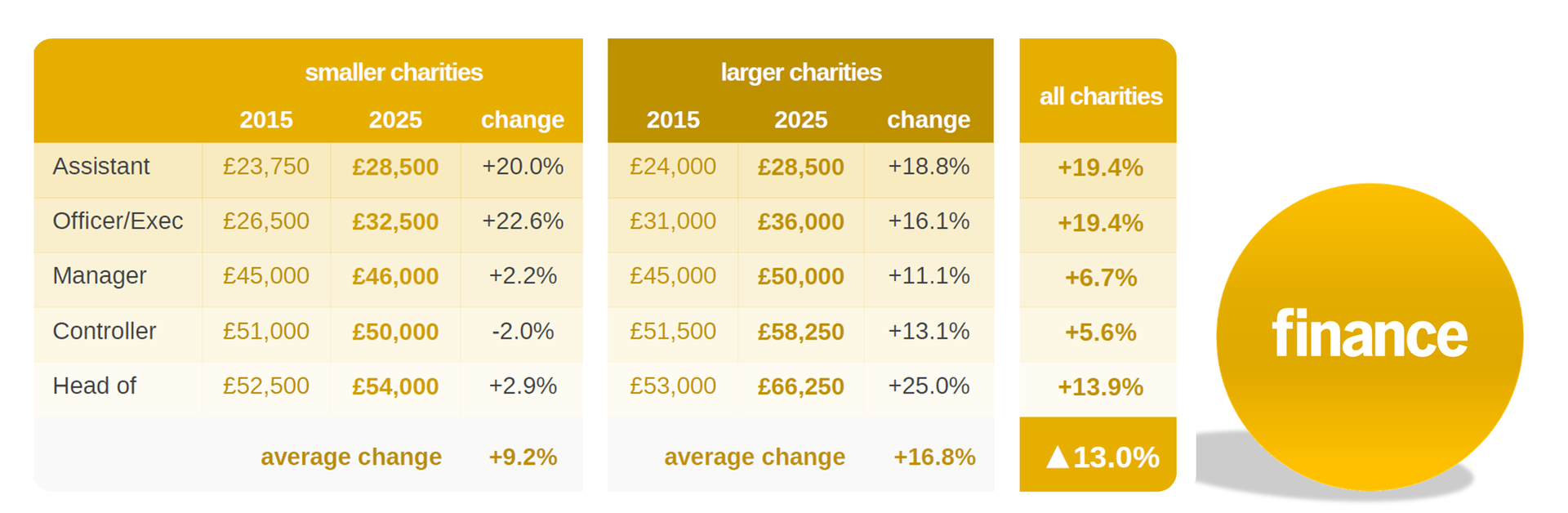
In Finance it's actually those in junior positions who've seen the strongest percentage increases, while progress has been more sluggish for their senior colleagues. With one exception: Heads of Finance at major charities, where a significant disparity between their pay and that of their equivalents in smaller organisations has opened up.
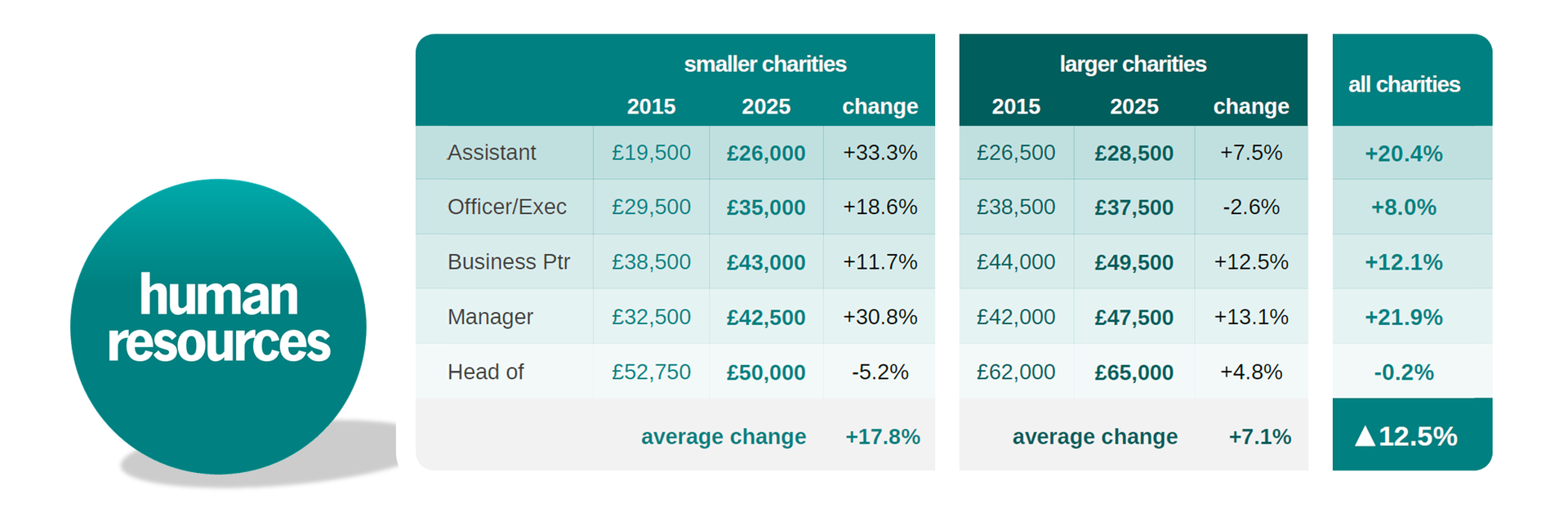
Human Resources
Not a great decade for heads of HR, whose salaries have largely flatlined and may even have slipped backwards in some cases.
Their junior colleagues have fared better in that respect, particularly in smaller charities where some of the most substantial rises have been seen, if only because their lower starting points left them a lot more ground to make up.
Marketing
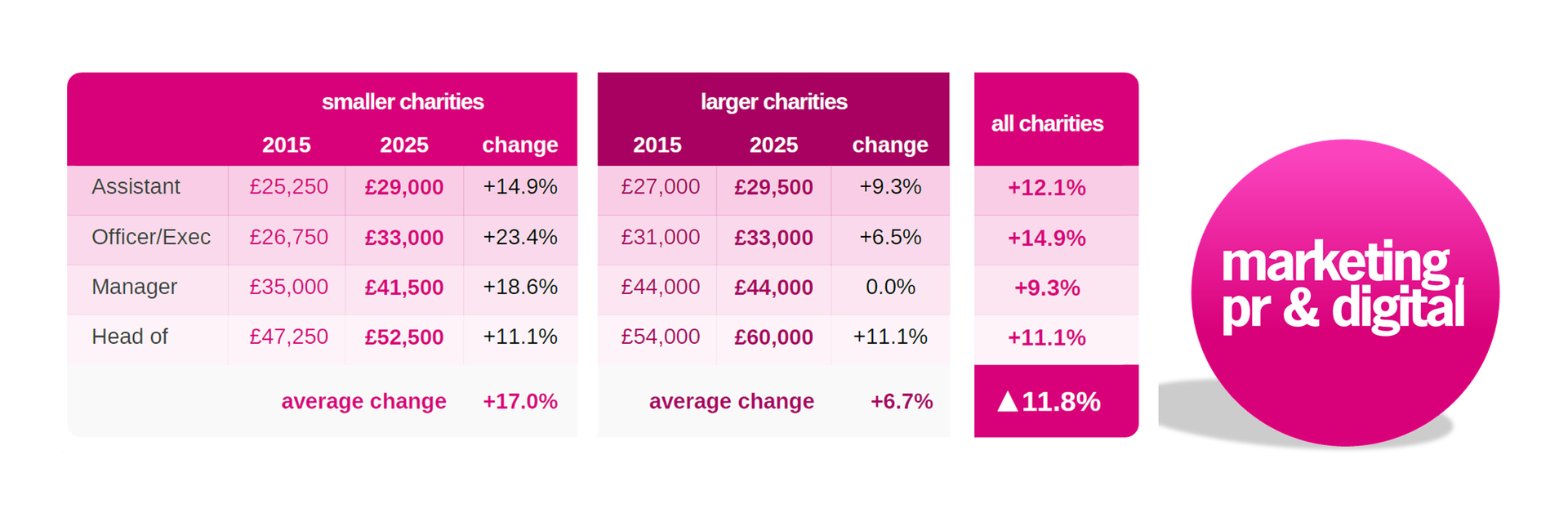
Given how infrequently ‘marketing’ and ‘salary increases’ have shared a sentence in previous editions, it’s no great surprise to see where the smallest advances have been, with salaries rising by a grand total of 11.8% since 2015 – just a fraction over 1% per year.
It’s the law of supply and demand at work, yet perhaps a little surprising given that a strong brand and compelling communications (particularly in the digital sphere) have only become more essential in the past ten years.
However, that 11.8% average masks quite a contrast between the story at smaller charities (+17%) and larger organisations (+6.7%), closing the gap between them to some extent.
What does this tell us?
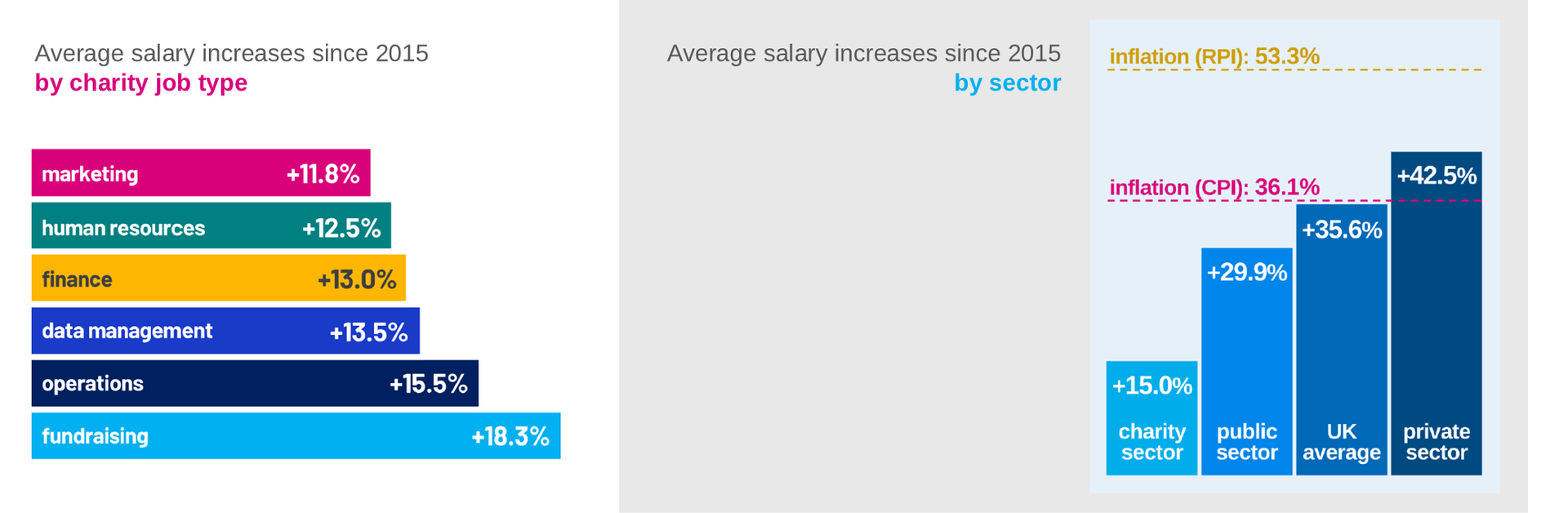
This shows there are some clear differences in salary increases between departments, albeit within a fairly narrow range (see below), which averages out at 14.1%.
However, given the greater number of fundraisers and operational staff than those in finance or HR, for example, 15% is probably a better estimate of the average increase across the sector.
It’s not a huge amount for a decade, but at least it’s movement in the right direction. At least, until you stir in the final ingredient of this salary soufflé: inflation.
► A quick sidebar: the Consumer Prices Index (CPI) and Retail Price Index (RPI) track different items to determine the rate of inflation, CPI giving a lower rate by some distance. Both have their merits and shortcomings but both are valid: the truth probably lies somewhere in between.
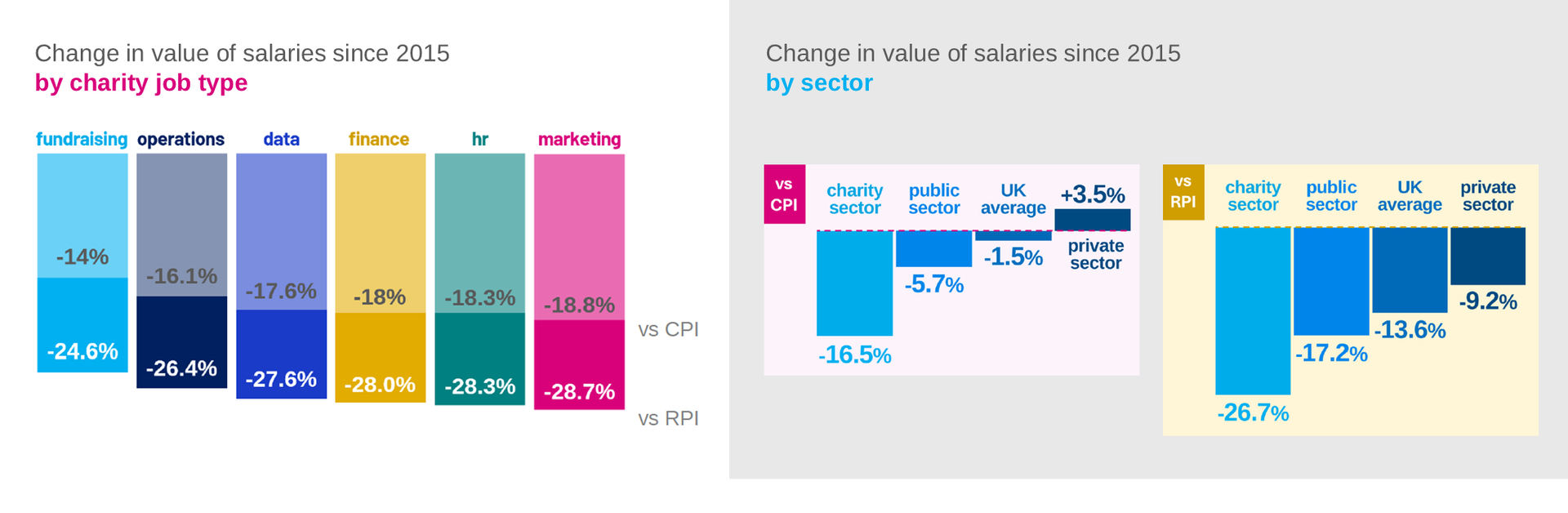
Having climbed just 15%, charity sector salaries have fallen well behind either measure, behind public sector pay (up 29.9%), and far behind the UK’s average full-time salary, up 35.6%, just a fraction behind inflation.
For most then, and certainly within the charity sector, there’s been no increase in real terms over the past ten years — the only question is how much the value of your pay has declined: marketers being the worst hit, but even fundraisers faring only slightly better.
Still, tell us again how wages are rising faster than inflation. We love that one.
By David Young
•
October 1, 2026
How's the recruitment market looking for those delivering their organisation’s services and providing essential support in areas like Operations, Admin, Data, HR and Projects? Here's our overview of the current trends from our 2026 Salary Survey.

By David Young
•
September 25, 2026
How can charity marketers best survive the current recruitment market, facing tough competition from their own weight of numbers, and now threatened by the electronic assistant to end us all? Here’s what our specialists had to say in the 2026 Harris Hill Salary Survey.