





Thinking of temping? Here’s what to consider…
By Nicola Greenbrook • January 11, 2024


How does temping work?
Working as an agency worker in the charity sector, commonly known as a ‘temp’, is not the same as being an employee or worker. Instead of being directly employed by the charity, you're employed by the 'employment business' that supplies agency temps (such as Harris Hill for instance).
In essence, you're on the agency’s payroll and entitled to their benefits. However, during your assignment, you will work under the direction and supervision of the hosting charity on a day-to-day basis.
Why do charities need temps?
Charities often rely on temporary or seasonal workers to fulfil various business needs and there are several reasons why they bring temps on board.
Some of these include:
• Seasonal fluctuations - Charities experience fluctuations in their workload, often tied to seasonality or a specific fundraising campaign. Hiring temps during this period can help meet an increased need.
• Niche/specialist projects - Charities frequently work on projects or tasks that require specific skills or expertise that may not be readily available internally, such as legacy fundraising.
• Cost-efficiency and flexibility - Hiring a temp can be more cost-efficient, especially when the need is sporadic. Charities can adjust staffing levels in line with changing needs without the long-term commitment associated with permanent positions.
• Equity, Diversity and Inclusion - Temporary staff can bring fresh perspectives and diversity to charities and can contribute a broad range of ideas and experiences.
• Covering absence - Temps can fill in for permanent employees during annual leave and sickness absence or to cover a sabbatical, career break or parental leave. They can also cover the interim period when a charity is waiting for a new hire to work out their notice period

Is it wise to consider temp work now?
If you are contemplating temp work, this could be the right time. In September 2023, a report by the Recruitment & Employment Confederation revealed that long-term economic uncertainty, increasing costs and budget restraints have affected hiring decisions. Consequently, the number of placements for permanent staff declined as organisations were hesitant to commit to new permanent hires and there was an increase in the reliance on temporary staff.
According to the Office for National Statistics (ONS) Labour market overview for November 2023, temporary work (and sectors like hospitality and healthcare) are performing better than permanent roles.

Why do people temp?
Temping has become increasingly popular over the last three years. The COVID-19 pandemic has fundamentally changed how people work, and it seems that things may never go back to the way they were before.
Temping is appealing to those who value flexibility, diverse work opportunities and adding different work experiences to their CV just as highly as salary and promotion. If you have multiple interests or creative endeavours or find the idea of being tied to one job, industry or role stifling, then you might well be a ‘multipotentialite' - a term coined by award-winning author Emilie Wapnick and discussed in her TED Talk, 'Why some of us don’t have one true calling'.
Moreover, the rise in the ‘portfolio career’ has opened up avenues for people to leverage multiple skills and interests and generate income from different sources.
Not everyone finds career success by pursuing a linear path, and temping provides a great opportunity to apply transferable skills across various roles and disciplines, regardless of age or stage in life.
According to Recruiter magazine, older workers are leading the way, with 41% of those exclusively doing temporary work aged 50-70. So, whether you're a university student looking to earn some extra money, a mid-career professional switching careers or someone who is semi-retired, temping can be a viable option.

What are the benefits of temping?
In a nutshell, plentiful! However, if you're new to temping or have a preconceived notion that's holding you back, don’t worry - you're not alone.
Harris Hill temp Dion explains:
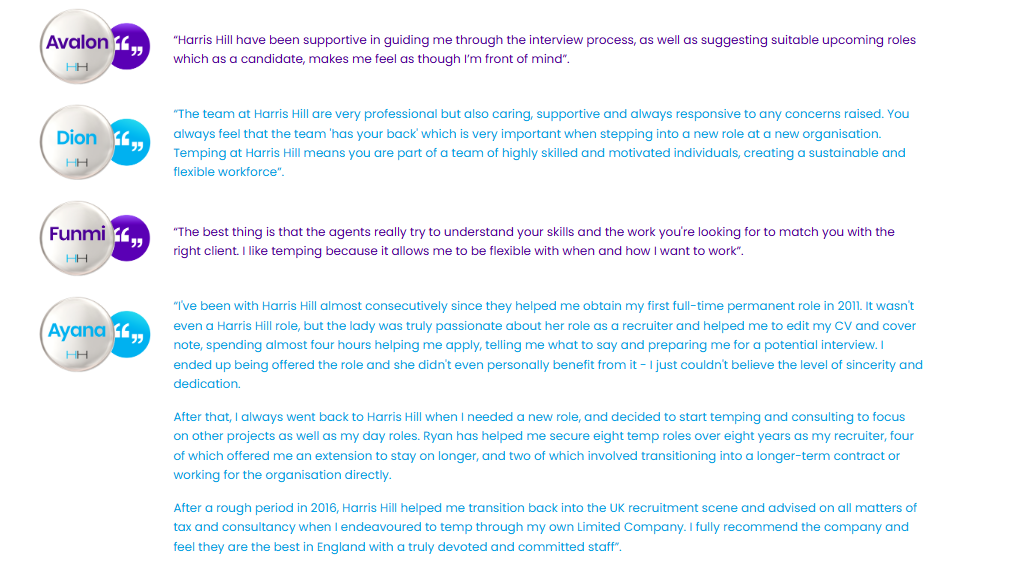
“Temping in the UK was a bit of a mystery to me as it's never been required in my working life to date. I contacted Harris Hill through a friend who is currently temping, as I'd been for several interviews but hadn't secured a permanent role. I always had a perception that temps were there just to help companies who needed cover.”
Charities hire temporary staff to meet their business needs, but temping can be advantageous for individuals too. Whether you're on a career break, in between permanent roles or running your own business, temping offers flexibility and the opportunity to experiment and gain experience in different work environments. It can give you some much-needed breathing space without the restraints of a longer notice period that is typically associated with permanent work.
Temping also demonstrates to potential employers that you are motivated, proactive, adaptable and hardworking.

Temping can introduce you to a different pay schedule compared to permanent work, with fortnightly or weekly pay that could better suit your budget, plus the accrual of benefits.
The Agency Workers Regulations 2010 grant temporary workers certain rights and entitlements, and after a 12-week qualifying period, agency workers are entitled to equal treatment regarding "basic working and employment conditions”. This may include pay, working time and annual leave (although to qualify for this, you must be working in the same role with the same hirer for 12 months, regardless of the hours worked each week). Dion says:
"I was put forward for a three-month role with the flexibility of working from home most days which meant no daily commute or stress but weekly regular income. I'm even accruing holiday pay! These roles offer both flexibility and regular income that suits an individual’s needs - making temping very attractive and worth considering for anyone.”
It can also help you to gain experience and develop skills in a particular field before committing to a long-term role. Fellow temp Avalon says:
“When I moved from Sydney to London over the summer period, I underestimated how long it would take to find the perfect permanent position. Luckily, temping through Harris Hill has provided me the ability to work in my desired field, build on my existing skills and get my foot in the door in the UK market”.
It can also be a great way to expand your CV, especially if you're someone who loves to learn, craves variety and is constantly curious. According to temp worker Funmi:
“I enjoy temping with Harris Hill because of the wide range of clients they have, and I always get interesting assignments. I've enjoyed the fact that over the years I've worked for many great organisations, which has enhanced my skill set through learning to use different databases and work processes".
Working as a temp in the charity sector can also help you achieve a better work-life balance by allowing you to set your hours around your family or other caring responsibilities, while making a difference to your community or supporting a cause you feel passionate about.

Working in the charity sector as a temp can provide you with more flexibility and breathing space, especially if you're considering making a change to your regular work routine. It gives you the chance to develop your skill set, learn new systems and processes and gain experience in a range of work environments.
Although it can be scary to make a career change, even a temporary one, you don't always need to take drastic steps to improve your work-life balance.
So, what are you waiting for?
Nicola Greenbrook, London based freelance writer, podcaster and HR Specialist
Many thanks to Nicola and contributors, and we hope that gives you a good indication of whether temping could be right for you.

Thinking of temping? Here are the next steps...
This is where you'd probably expect us to point you in the direction of our very own temps team, and you'd be absolutely right (feel free to award yourself a biscuit, or at least loiter in the vicinity of a rice cracker if you've sworn off enjoyable snacks). That's because the agency you choose to work with will have a big impact on your experience of temping.
For best results you'll want one with a regular stream of temp vacancies in your chosen field, so that ideally you can have the next placement lined up before the current one ends, avoiding unwanted gaps.
However, for the right jobs to start coming your way, your agency needs to have a good understanding of who you are: your skills, experience, aspirations and the kind of roles you're looking for. That's a two-way process, so the more detail you can share about your strengths, requirements and availability, the better your recruiter's understanding will be. Then if they're listening to your needs, you won't be bombarded with unsuitable opportunities, just those that are genuinely worth considering.
If you're reading this, you've found at least one such agency already, so we'd suggest having a chat with our highly experienced temp specialists Ryan Elmer, Sekai Lindsay and Hannah Gibson, who take pride in providing a great service for temporary workers in the charity sector.
If you're considering temping or would like to discuss potential opportunities, just get in touch with the team via the details below.
Ryan Elmer, Divisional Director ▪ 020 7820 7313 ▪ ryan.elmer@harrishill.co.uk
Sekai Lindsay, Principal Consultant ▪ 020 7820 7307 ▪ sekai.lindsay@harrishill.co.uk
Hannah Gibson, Senior Consultant ▪ 020 7820 7328 ▪ hannah.gibson@harrishill.co.uk

Latest Posts

By David Young
•
October 1, 2026
How's the recruitment market looking for those delivering their organisation’s services and providing essential support in areas like Operations, Admin, Data, HR and Projects? Here's our overview of the current trends from our 2026 Salary Survey.

By David Young
•
September 25, 2026
How can charity marketers best survive the current recruitment market, facing tough competition from their own weight of numbers, and now threatened by the electronic assistant to end us all? Here’s what our specialists had to say in the 2026 Harris Hill Salary Survey.

By David Young
•
September 17, 2026
How much can charity CEOs expect to earn in 2026? It's a big question, but if anyone knows, it's the hugely experienced specialists of our Executive Search team, and here's what they had to say about the current market in our 2026 Salary Survey.