

Robots vs Recruiters: How is AI changing charity recruitment?
David Young • July 8, 2026
Love it, loathe it, or side-eye it from a safe distance, artificial intelligence is here and fast becoming an inescapable fact of life, like ageing, taxes, or Ed Sheeran.
Undeterred by the occasional IT system running solely on duct tape and hope, it’s even infiltrated the charity sector and in turn, the charity recruitment process. But is it helpful? Is it harmful? Can it suggest a low-fat recipe for cheesecake? And more importantly, can it improve on existing methods of hiring the best new talent for your team?
It's a fast-evolving field, but here's a look at where things stand at the time of writing, in the long and dangerously-hot summer of 2026.
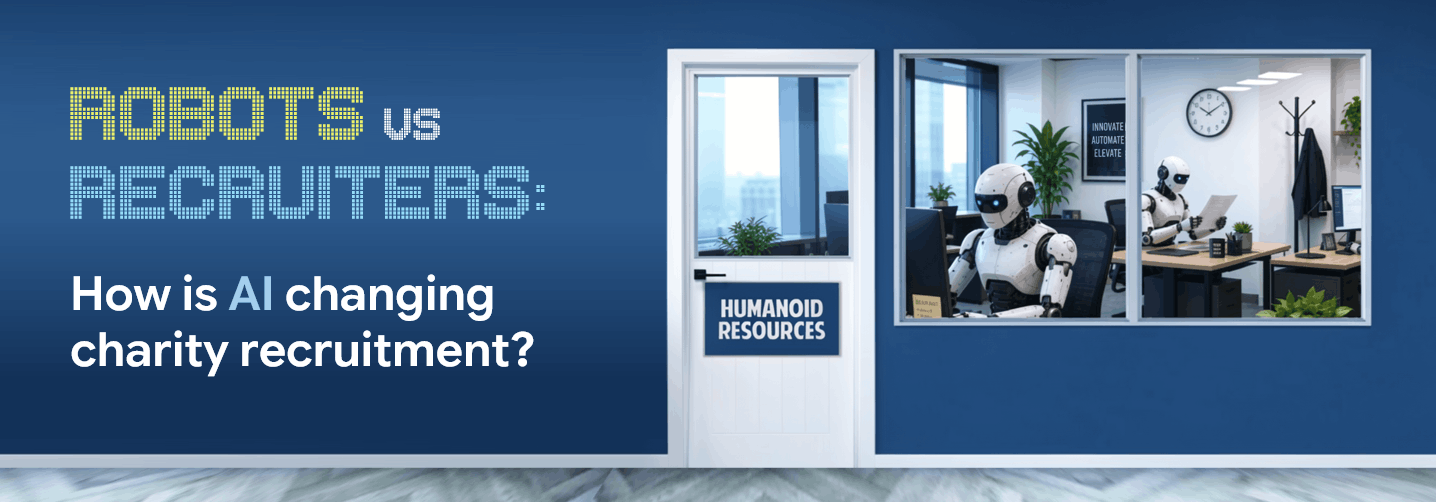
Why is AI gaining traction in the charity sector?
Early insights from the forthcoming 2026 Charity Digital Skills Report reveal that 88% of charities are now using AI tools in their everyday work, up from 76% a year ago, and while only 5% claimed to be using it for recruitment or HR purposes at the time, everything we’ve seen over the last 12 months suggests that figure is steadily rising.
For applicants, the appeal of AI is obvious and near-irresistible. Completing job applications, CVs, cover letters and supporting statements can be time-consuming and tiresome, and all the more so when you’ve already sent 20 this month and got nothing but crickets.
Job-seekers were sure to seize upon anything that can make it less of a soul-destroying slog, and indeed, CharityJob research in June 2025 found that 64% of charity candidates were using AI to help with applications, another number that has undoubtedly continued to rise.
Meanwhile, employers are increasingly using AI to simplify and speed up their side of the process: drafting job descriptions, searching CVs, preparing interview questions and swiftly identifying the strongest matches in a stack of applications that in the current market, can often run into the hundreds.
For busy hiring managers, this can be enormously useful and what’s more – aside from perhaps our souls and the future of humanity – it comes at little to no cost, making it a very appealing option for charities with tight budgets and overstretched teams. Or as they’re otherwise known, charities.
Understandably, this raises a question that we’re encountering ever more often…
‘We can use AI, so why would we still need a recruiter?’
It’s a fair question, and as specialist recruiters for the charity sector, we can't pretend to be entirely impartial. However, we do believe there are some objectively good reasons to be wary of putting all your recruiting eggs in AI’s fancy new virtual basket.
So buckle up, because we're about to list them.

A question of trust
One of AI’s biggest shortcomings right now is that while it can provide a plausible-sounding answer to just about anything you ask, those answers can be less than reliable.
Ask for advice on how to do something – the most idiotic, harebrained scheme you can think of – and it will tell you a) how to do it, and b) that it’s a great idea.
Point out a problem with the plan and it will agree, correct itself, and lavish you with praise for being so observant. But the fact it hadn’t flagged up the issue, nor the fundamental foolishness of the whole idea, raises serious questions about the reliability of its advice. Being able to single out the strongest applicants in seconds could be hugely beneficial, but not unless you can be confident it will have made the right decisions.
More than (key)words
AI is great at matching skills on CVs with those in the job description, but as any real-life recruiter will know, ticking all the right boxes on paper doesn’t necessarily make someone right for the role.
After all, most of us would like to think we’re more than merely the words on our CV, and we’d be absolutely right.
For a successful match, there’s a lot more to consider: character, outlook, personality, experience in other areas: things that individually, AI might deem irrelevant, but together, might combine with someone's skills to make them perfect for the position. Understanding the context and seeing the full picture is crucial, something that humans - even recruiters - are simply better-equipped to do.

What's your motivation?
Having the right skills and experience matters, but there’s an added dimension to charity recruitment that AI can struggle to capture: why does an applicant want this job?
Sure, in the commercial world you’ll have to pretend to be passionate about plastic widgets if you want to work at the plastic widget place, but there's a general understanding that a) it’s simply the game you have to play, and b) it doesn't really have to be true, as long as you can fake it reasonably convincingly when required.
However, motivation matters a great deal more in the charity sector – people’s genuine interest in and commitment to the cause can be a big factor in how they fit with the team, how long they stay with the organisation, and much more.
It’s also something that can be challenging to convey on paper, making it difficult for AI to detect, whereas simply through conversation, a real-life recruiter will sense it instinctively from a candidate’s tone, expression and countless tiny visual, physical and linguistic clues, giving humans the upper hand here too.
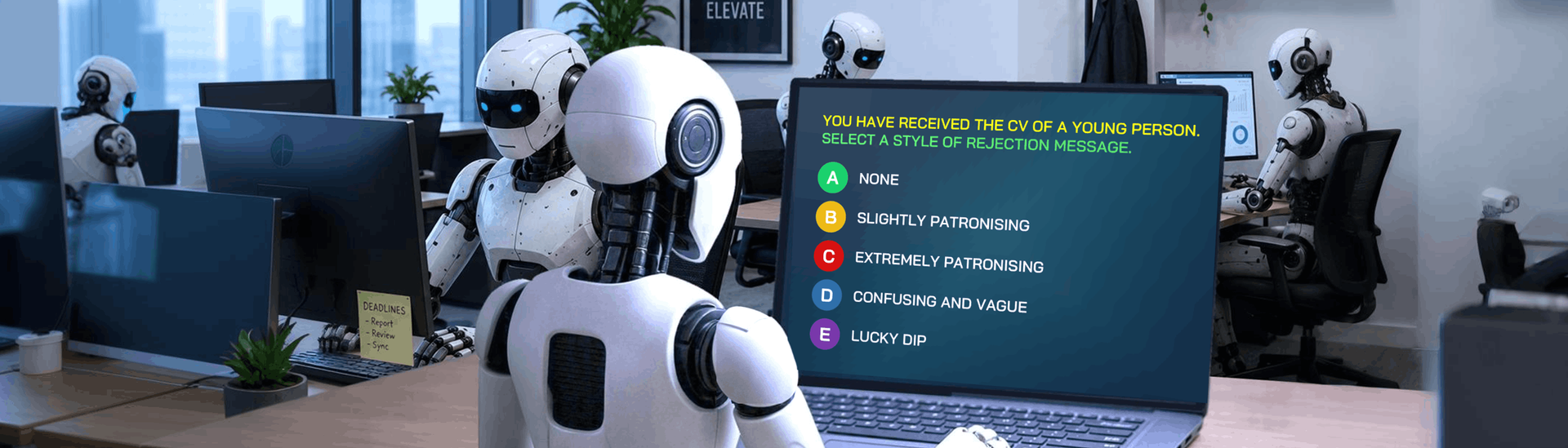
AI vs EDI
You won't need us to tell you about the benefits of a diverse and inclusive organisation, but it’s worth noting that AI can be more of a hindrance than a help in this respect.
To a significant extent, AI relies on identifying and repeating patterns, which makes it ruthlessly efficient at bringing you more of the same. You'll see this when you buy a washing machine and spend the next few months - surely the point when you're least likely to buy one - being cyberstalked by ads for yet more washing machines (how many do they imagine you need?!)
In a recruitment context however, it can be rather more consequential, as steering you towards candidates very much like the ones you already have is not a recipe for diversity, but quite the opposite.

But using AI is quicker!
It certainly has the potential to expedite the hiring process, but from where we're sitting, it's not yet clear that it consistently does.
Undoubtedly, there are parts of the process, like searching for suitable CVs, that AI can race through in far less time than a mere recruitment mortal.
But when it comes to choosing between them, unless you trust its judgment implicitly – and we’ve already covered several reasons why you might not - the chances are you’re still going to have to review them in the old-fashioned, manual way: a task that, ironically, AI has made rather more time-consuming than it used to be.
Why? Because back in olden times, by which we’re talking pre-2023, you could generally expect any significant volume of applications to span the full quality spectrum from the wonderful to the what-on-earth-is-that?, making it relatively easy to pick out the top 10-20% straight away.
However, having AI's assistance has raised most applicants' game, leaving only a handful of genuine clunkers that can be taken off the table, and a huge number clustered together in the general vicinity of ‘quite good’. As a result, determining which of them should make the shortlist has become a more complex task, requiring significantly more investigation, exploration and often quite lengthy conversations.
Handling all this tends to be far more time-consuming than people initially expect, and even more so when it’s something you’re trying to fit in around your actual job.
It takes time for recruiters too, but the difference is that it is their actual job, which means they can give it their undivided attention, with all the resources and systems in place to glide through it swiftly like a well-oiled machine. On a good day, at least.
As the core focus of their job, they can also be more readily available to candidates and respond to them much more quickly, which makes for a better experience all round and, we would argue, better results.
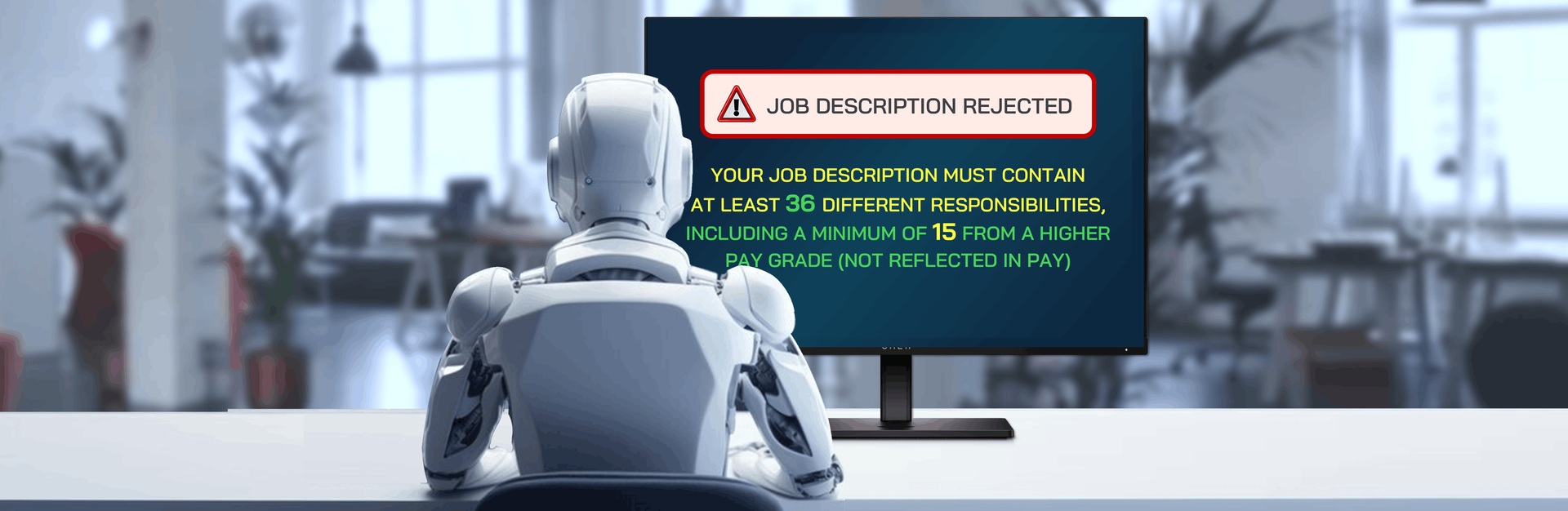
But using AI is cheaper!
Is it, though? Certainly, if everything works out well, it can save a recruitment fee, but even with AI’s assistance, dealing with a high volume of applications is always going to demand a lot of your time, and time – as you’ve probably heard – is money.
And that's not the only cost to consider. Recruiting tends to demand your immediate attention - leave candidates waiting too long and you lose them - so you'll also need to factor in the costs (financial or otherwise) of your other projects being delayed.
There's also the cost of advertising the position, which can be significant on the major job boards, but through at least one excellent specialist recruiter (*waves frantically*) would be absolutely free.
And after all of this, if your AI hire turns out to have been a mistake, you'll be stuck with the full costs of repeating the campaign from scratch. Most recruiters, by contrast, will offer some kind of protection against this, such as a sizeable rebate, or re-running the campaign at a significant discount, sometimes even for free.
It's a strong incentive for them to get it right first time, and an offer they can make precisely because it's so rarely needed. Think of it like renovating your kitchen, or having an operation: there's a much lower risk of a poor result if you entrust it to experienced professionals who do it all the time, rather than getting your mate who dabbles occasionally to give it a go.
Put all of that together, and you might find that relying solely on AI (which realistically, means doing a lot of the work yourself) is actually less cost-effective and a greater risk than more established recruitment methods.

Robots or recruiters: what's the future of charity recruitment?
Sound the giant cop-out klaxon now, but we're going to have to rule in favour of both, as there's actually no conflict here. Success in future will most likely depend on combining the two, blending the advantages of AI with the benefits that recruiters bring to the table.
AI is already embedded in charity recruitment and very useful for certain things – recruiters use it themselves for candidate searches, and increasingly to help draft job descriptions and adverts, where it's not overly difficult for AI's efforts to sound more natural and human than those of actual humans.
Meanwhile applicants' enthusiastic embrace of AI has started to reshape the recruitment process altogether. Having rendered everyone's covering letters and supporting statements almost identical, many organisations we've spoken with have simply stopped requesting them, and that's unlikely to be the last change we see.
Ultimately, the future of charity recruitment is almost certainly collaborative, harnessing AI for speed and structure, while relying on human recruiters’ judgement, experience and insight. Over time, AI's abilities will surely improve, helping recruiters to provide an ever-more effective service too - and to answer the question we started with, AI might not always outshine existing recruitment methods in every respect, but it's certainly a valuable addition.
-------------------
Turns out it can also find that cheesecake recipe, so we're off to give it a whirl. Salted caramel, no less. Granted, the baker demonstrating it appears to have thirteen fingers, but that’s AI for you.
Bon appetit!
Team HH

If you'd like to know more about the use of AI in charity recruitment, or discuss an upcoming role or recruitment challenge, contact our specialist consultants who'll be delighted to help.
Alternatively you can reach us on 020 7820 7300 or info@harrishill.co.uk,
or make your choice from the buttons below.

By David Young
•
October 1, 2026
How's the recruitment market looking for those delivering their organisation’s services and providing essential support in areas like Operations, Admin, Data, HR and Projects? Here's our overview of the current trends from our 2026 Salary Survey.
By David Young
•
September 25, 2026
How can charity marketers best survive the current recruitment market, facing tough competition from their own weight of numbers, and now threatened by the electronic assistant to end us all? Here’s what our specialists had to say in the 2026 Harris Hill Salary Survey.